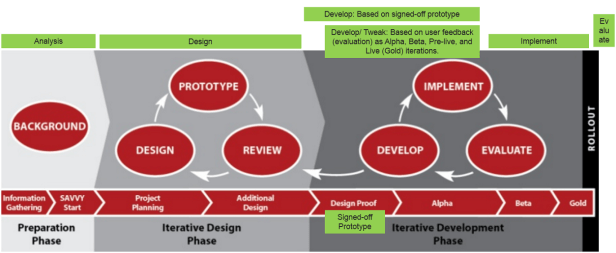
The Successive Approximation Model (SAM) has been an on and off topic of discussion in the training industry for several years, and raises its head from time to time even now. I’m not sure I see the big controversy here. I’ve always felt that the methodology proposed by SAM was always present in practice within ADDIE (Analyze- Design- Develop- Implement- Evaluate). Indeed, my colleagues and I have always worked with the SAM methodology but called it ADDIE 😀
Here is my personal understanding of SAM vs ADDIE.
The e-learning industry’s primary interest in Agile methodology lies in the concept of incremental, iterative, production (Sprints). Agile proposes designing the final product in smaller, incremental, chunks, testing these chunks continually with sample audiences, tweaking the design based on audience feedback, and creating the final product based on a sum of incremental feedback and tweaks. This helps the process in two critical ways: cost savings since the end users’ feedback is continually integrated into the product, and greater user adoption of the final product by building familiarity along the way.
Truth is, experienced e-learning agencies and professionals have been designing e-learning in an iterative and incremental manner within the broad framework of ADDIE since the late ’90s. And this wasn’t something new we came up with- it was borrowed from ‘old media’, for e.g: architecture, product design, advertising, radio, TV, and film, where it was established practice to first design a ‘blueprint’, a ‘prototype’, ‘pitch’, ‘spot’, or ‘pilot’ to test with a sample user group.
It is here that the historical context of ADDIE vs SAM becomes important. Two of the most important events pertaining to this discussion took place in the beginning of this millennium: The Agile Manifesto was launched in 2001, and the first two self-design e-learning software- Macromedia (Adobe) Captivate and TechSmith Camtasia- were released in 2002. The release of Captivate and Camtasia are watershed events in the history of the e-learning industry, as they finally gave business organizations tools to bypass the e-learning agency and create e-learning on their own.
However, this also meant that e-learning was being designed for the first time by an audience with little to no experience of designing online content. Business organizations were inexperienced of how ADDIE is used in practice- its detailed nuances, project based modifications, challenges, and workarounds. Needless to say, the first few waves of e-learning courses designed internally at organizations turned out to be quite challenging. It is here that Michael Allen proposed the Successive Approximation Model (the model was proposed a few years before the book release in 2012). Rather than trying to retrieve ADDIE, which was already criticized, Allen proposed SAM, a ‘new’ model. Personally, I think SAM presents decades of tribal knowledge from e-learning Agencies (ADDIE in practice) using terms from the new Agile methodology.
SAM was a great help for the fast changing industry, as it helped address many of the challenges faced by first-time e-learning developers.
Since E-learning derives its essential inspiration from universal design principles and from design thinking, concepts like prototyping and user testing are intrinsically in-built into the e-learning design and dev process, and thus into both the ADDIE and SAM frameworks. These are practiced as sub-steps and sub-processes, and often not as visible as the general framework. The glossary of terms also differs across ADDIE, Agile, and SAM, and this can imply that we are perhaps missing critical substeps from ADDIE, simply because they exist with a different name.
To conclude:
- Interpreting ADDIE as just a shell without looking at its substeps is reducing its scope and flexibility as a framework.
- SAM is not a radical new idea. The concepts it proposes were practiced as sub-steps within ADDIE for many years prior to SAM (and still are).
- I prefer ADDIE because it is a high-level process that can be customized based on the needs of a project.
- The guiding principles of SAM (the process must be iterative, support collaboration, and be efficient, effective, and manageable) are well addressed by ADDIE.
- Fifth and last, ADDIE is neither a linear nor an exclusionary process. It borrows liberally from project management and change management principles, design thinking and LEAN methodology, etc. The trick is to be flexible and customize ADDIE based on the needs of the project. SAM is simply one such customization of ADDIE.
(Below: SAM Model 02 shown in grey and red. Green labels show how ADDIE maps to SAM.)